
5 Thai Desserts You Should Try
Sweet Treats in Bangkok
Thai desserts simply have to be tasted when visiting Bangkok, and there are loads to choose from. Thai cuisine has a deep tradition of delectable desserts that often play on the indigenous flavours of coconut, fresh fruit, and sticky rice.
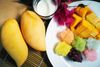
The king of all Thai desserts is mango sticky rice, and you can’t say a trip to the Kingdom is complete without at least 1 try, but there are other less well-known sweets to try, too. Here are a few desserts that any self-respecting sweet tooth would be wise to sample while in Thailand.
1. Mango and sticky rice
Khao niew mamuang

适合: 餐饮
What do you get when you add slow-cooked coconut sticky rice, and decadent coconut cream to some of the world’s most delicious mangoes? The answer: a treat worth writing home about – khao niew mamuang.
This popular dessert can indeed be found in Thai restaurants all over the world, but it always seems to taste better in Thailand. One reason is the quality of mangoes – there’s just nothing like the sweet, golden and amazingly cheap mangoes produced within the Land of Smiles. If you’re seeking something more adventurous, look for coconut sticky rice with slices of notoriously pungent fresh durian in place of the mango.
Where to try it: Quality coconut sticky rice with mango is widely available throughout the city, including from several vendors on Khao San Road. The durian version can be more of a challenge to locate, but you might find it in Pak Khlong Talad flower market, in the fresh fruit section along the sidewalk towards the north of the market.
2. Thai pancakes
Roti
适合: 餐饮
These yeastless pieces of bread resembling pancakes actually originated in India and can be found throughout South and Southeast Asia. Ever popular among Thais, roti deserves a place on the list of must-try Thailand sweets. Thai-style roti is crafted by swiftly and continuously flipping dough on a hot, greased skillet until it reaches just the right consistency – flaky on the outside and soft in the middle. Roti can be ordered plain (tammada) or with fillings like banana or pineapple, but a drizzling of sweetened condensed milk on top is a must. Even watching the quick hands of a roti master at work is an experience in itself.
Where to try it: Roti vendors can be found throughout Bangkok, including on Khao San Road. For the best, however, head over to Roti Mataba Restaurant across from Phra Sumen Fort, near the river on Phra Athit Road. The folks at Roti Mataba are Bangkok’s unequivocal roti gurus as they’ve been in business for over 60 years.
地址: Bangkok

3. Coconut ice cream
I-tim ma phrao
适合: 餐饮
Although the western-style ice cream was first introduced to the Land of Smiles by foreigners, Thailand has adapted it to create its own unique versions. Some of Thailand’s icy treats, like nam kang sai and tup tim kab, are more reminiscent of shaved ice. Both consist of plain, pounded ice with some combination of sweet-flavoured syrups, coconut milk, sweet gelatin, or fresh fruit added on top.
These are tasty indeed, but the best frozen Thai treat is i-tim mat phrao. Made with coconut milk rather than cow’s milk, Thai ice cream is both sweet and refreshing, and locals often take it with kernels of boiled corn or gingko biloba sprinkled on top. A more literal depiction of the “ice cream sandwich”, many Thais also enjoy i-dtim mat phrao wedged between a folded piece of white bread.
Where to try it: Street vendors selling coconut ice cream can be found wheeling around all parts of the city, but be careful not to mistake them for the regular, low-quality ice-cream sellers. You’ll recognise the real deal by the tall, round, stainless steel canisters used to keep the ice cream frozen. If you fail to spot an ice cream cart, an authentic i-dtim mat phrao vendor sets up most late afternoons just outside the Lumpini Park entrance, closest to the Silom MRT Station, Rama V monument and Silom Road. If you’re touring Thonburi’s canals, keep your eyes peeled for floating ice cream vendors navigating the waterways in their tiny longtail boats.
4. Luk chup
适合: 餐饮
The bright and shiny bite-size sweets known as luk chup stand out as one of the world’s most brilliantly colourful cuisines. A distinctly Thai adaptation of a sweet almond snack that was introduced to Thailand by the Portuguese in the 1600s, luk chup is made by boiling mung bean, sugar and coconut milk into a pulp, before it’s kneaded into the uncanny shapes of miniature cherries, oranges, watermelon slices, eggs, or even cute little piglets! As a finishing touch, colourful jellies are artistically applied, and the adorable finished products are almost too pretty to eat. Although the rich (and not at all fruity) flavour is memorable, the colourful experience is half the fun.
Where to try it: Luk chup is readily available in most large-scale food markets such as Or Tor Kor Market near Chatuchak Weekend Market. Baan Luk Chup Café, just past Arun Ammarin Soi 37 in the Bangkok Noi area of Thonburi, has been offering a wide array of styles and colours since the 1970s.
5. Sweet sticky rice wrapped in banana husks
Khao niew bing
适合: 餐饮
The process of making khao niew bing (or khanom bing) starts with slow-cooking sticky rice in a traditional Thai basket along with coconut milk and sugar before it’s moulded around hunks of banana or sweet taro root, wrapped up in banana leaves, and finally grilled over a fire. What emerges from the natural wrapper is a distinctly Thai treat featuring a warm and gooey inside to go with a slightly charred, crispy outside.
Khao niew bing are usually not overpoweringly sweet, but the undertones of coconut and fruit, along with smoky hints from the grilled banana leaf, make them a worthy accompaniment to morning tea, or as a late-night snack to satisfy both your sweet tooth and your hunger.
Where to try it: The strip of food stalls lining the sidewalk in front of Platinum Shopping Mall in Pratunam is a good place to find khao niew bing, as well as similar variations like khanom jaak (coconut meat fire-roasted with sticky rice in a particular palm leaf) and khao lam (sticky rice stuffed in a hollow piece of bamboo along with peanut and sweet bean , which is then grilled). Before purchasing, be sure to ask, “wan mai?” (“is it sweet?”). There’s no shortage of Thai foods that come wrapped in banana husks or other leaves, so make sure you confirm what’s inside before you buy to avoid any surprises.
地址: Bangkok

本文包含 Go Guides 编辑团队的意见。Hotels.com 好订网对作者出现在本网站上的文章给予补偿;此类补偿可能包括差旅费和其他费用。